
Q9. GROUP INSURANCE IN SUPER – IF ONLY ONE IN THREE MEMBERS UNDERSTANDS THEIR COVER, IS THE SYSTEM WORKING AS INTENDED?
According to CALI’s 2026 Life Insurance Sentiment Tracker, only one in three Australians understands the life insurance products and benefits they hold. Despite this, insurance through superannuation remains the largest source of life insurance cover in Australia and an important mechanism for protecting millions of Australians and their families.
What does this apparent engagement gap tell us about the current group insurance system?
In your answer, consider whether the challenge lies in member engagement, communication, product design, trustee responsibilities, legislative settings or some combination of these factors. What reforms should be prioritised to improve outcomes for members?
Insurance in super was born out of low engagement, providing the soft landing of a parachute to millions of working Australians who would otherwise not have protection when they need it. Its impact is significant - with $6 billion paid out by the life insurance industry, to over 54,000 people in the last financial year (1) – demonstrating just how often the parachute is deployed.
But having a parachute is not the same as knowing how to use one. Australians generally know they have one, and most trust it will do something useful if they need it — yet far fewer understand what, exactly, it will do for them. Council of Australian Life Insurers (CALI) research found that only one in three members understand the life insurance products and benefits they hold (2), a gap that becomes important when the ripcord needs to be pulled.
This essay considers the same three questions asked by skydivers after pulling their ripcord – Is it there? Is it square? Can I steer it? – to understand what the research into member engagement tells us about the group insurance system. It also explores the drivers of the engagement gap – spanning complexity of product and the group insurance ecosystem, access to advice, and member communication – and applies behavioural insights to shape opportunities for reform.
Insurance in super is the parachute designed to soften a bumpy landing when life throws you off course and you’re forced to bail. But before pulling that ripcord, there are three questions that every skydiver should answer:
Is it There?
Do members know they have insurance in super? And does the parachute open?
Approximately 8.8 million Australians are protected by insurance in super, with this number growing year on year (3). It is estimated that about 6 million of these would otherwise have no protection (3).
Across Australia's 11 income support systems, close to $80 billion was paid out in income support last financial year to around 8 million people — 2 million more than a decade ago (4). Life insurance accounted for $6 billion of that support, paid to 54,000 people or their beneficiaries (1), and it is estimated that around 30% of those covered through insurance in super will have a claim paid to them or their families at some point (5).
Awareness of insurance is increasing – with TAL finding 74% of people were aware of their insurance status, whether they had cover inside super, outside super, or not at all (6), aligned with Super Consumers Australia’s Pulse Survey, finding 73% had awareness of their insurance status (7).
The default nature of insurance in super is necessary for participation, and the number of members who rely on it when things go wrong proves its value.
Is it Square?
Do members understand the value of having insurance in super?
The research is reassuring.
Australians consistently recognise the value of life insurance products – with CALI finding the top reason people choose life insurance being for financial protection and a sense of security for loved ones (46%) (2). This holds, even when understanding of the specific cover remains low – with CALI finding 70% of people have a limited understanding of life insurance (2).
TAL’s research supports this – with 60% of members with insurance in super saying they rely on the financial protection it provides, and a further 33% recognising its value even if they don't expect to need it (6).
Can I Steer It?
Do members understand their cover, and can they manipulate it to feel confident it will meet their needs and adequately soften the landing?
Research suggests many can’t.
CALI found that one in three members have a limited understanding of the cover they have - and this matters because it isn’t awareness that drives financial confidence, it is understanding (6).
According to TAL's research, knowing your cover amount makes a real difference. Among the 29% of respondents who had default cover and were aware of it, 46% knew their cover amount, while 54% did not. Of those who knew their cover amount, 64% felt adequately protected, compared to just 42% of those who didn't (6).
As shown in the chart below, financial confidence increased where people went beyond awareness to actually make a decision about their cover - whether adjusting it or seeking additional cover to suit their needs inside or outside super (6).
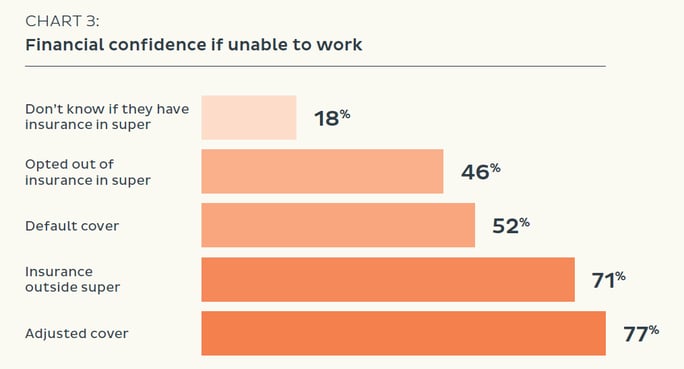
TAL Whitepaper ‘Making Insurance Matter: How super funds can help their members build financial confidence’.
Where Does the Challenge Lie?
If members aren’t able to steer the parachute, the question then is why? When unpacking the challenges, it is apparent there is not one single point of failure.
Member Communication - Not Meeting Them Where They Are
Trustees are responsible for explaining features of the group insurance product offered to their members, as well as designing how they do this – the availability and accessibility of information, and the processes for members to make changes (8). ASIC noted some improvement in member communication since its earlier research found a third of members felt confused, overwhelmed or uncertain when engaging with their fund about insurance (9), but it highlighted a need for Trustees to further improve communications and processes to support member decision-making (8).
In practice, members often receive communication about their insurance coverage in an annual member statement – buried amongst other information, and with friction involved in finding out more about their cover. Marketing campaigns aimed at insurance are often generic and rarely timed for a moment when a member’s circumstances are changing where it would be relevant. Self-service tools such as calculators do exist but require effort to find and engage with.
More significantly, vulnerable members are often not served well by current communication methods. Research highlights members in Indigenous or remote communities are least likely to understand or receive insurance communications - where reliable contact details, digital literacy and engagement is assumed (10). The FSC’s guidance note on vulnerable members flagged this as a gap for Trustees to explore (11).
Cost and Access to Advice
For members who do want to understand their insurance in more detail, current legislative settings impose a high threshold before advice can be tailored to member circumstances. Providing personal advice triggers a number of obligations, including best interests’ duty, along with lengthy paperwork to document compliance (12).
As a result, funds are largely limited to general advice – communication that cannot be tailored to member circumstances. The exception being intra-fund advice which is a limited form of personal advice – but with a restricted scope (13).
This limited pathway to support members is at odds with what members want. Research shows that 87% of members trust their fund to help them understand their insurance needs and 55% believe insurance education is their fund’s responsibility, yet intra-fund advice was largely unknown to members and significantly underused (6).
Access to advice beyond the fund is also constrained due to cost involved, as well as reduced numbers of advisers. Australia’s financial advisor numbers have fallen by 48% in under 8 years, driven by regulatory reform, and lengthy qualification requirements (14). The Financial Advice Association of Australia itself estimates around 15.9 million Australians currently have unmet advice (14).
Product Design and Disclosure
Policies and disclosure documents (Product Disclosure Statements and Insurance Guides) for life insurance products are dense and technical, involving a lot of jargon that is not conducive to engaging members to understand their cover. ASIC found that simplifying disclosure documents alone does not reduce the complexity of insurance in superannuation, where a product is not simple to begin with (8).
Many policies include “Life Events” provisions – allowing members to increase their cover at key life moments when it matters most - including marriage, birth of a child etc. However, these are often buried in lengthy disclosure documents, with no prompt when the moment arrives as to the existence of the clause – meaning members are unaware of these opportunities.
A Complex Insurance Ecosystem
The fragmentation of the group insurance ecosystem – involving the fund, insurer and often an administrator – creates complexity and limits access to data for a real-time view of member interactions across the ecosystem to support trustee oversight and a seamless member experience – to meet their needs directly, regardless of the ecosystem partner required to support them.
Despite the challenges outlined above, the evidence indicates that the barrier to engagement is generally not around belief in the insurance provided to members inside super, it is around enabling action.
Design for Reforms
When recommending reforms to address the challenges identified, it is essential to consider behavioural insights research to better understand what drives people’s actions and choices.
The COM-B behavioural economics model can be used to identify what needs to change in order to improve the engagement of members with their insurance (15). The three factors in the image below need to be present/improved to drive engagement.
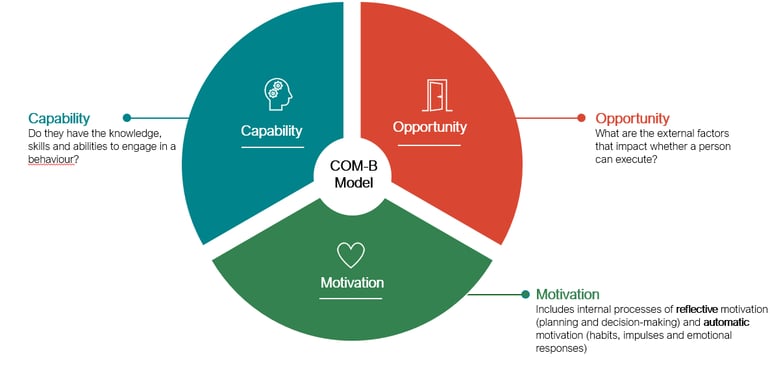
Adapted from content in (14)
Complementing the COM-B model, the 4 principles of the EAST Framework, developed by the UK’s Behavioural Insights Team, provides guidance on the design of suggested reforms. The EAST framework has been used to develop effective public policies and communications to encourage behaviour change (16).
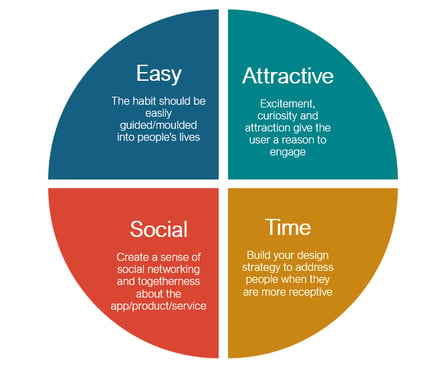
Adapted from content in (15)
Reforms to Improve Outcomes for Members
Drawing on behavioural insights research, three key reforms are proposed to help close the gap between members knowing they have insurance in super – and members truly understanding it.
Improved Advice Pathways
Financial Services Minister, Dr Daniel Mulino’s announcement on 19 August 2026, on policy direction for Delivering Better Financial Outcomes (DBFO): Tranche 2, has been welcome news for the industry after an 18-month consultation period. Dr Mulino said the changes “ensure access to safe, reliable financial advice” (17). Key reforms discussed that will directly address the cost and access to advice for members include (18):
-
Targeted Prompts will allow funds to leverage data to send targeted (personalised/attractive) and timely nudges to members at key life stages.
-
Client Advice Records will provide flexibility and reduce requirements for advice records (including option for phone-based records) – replacing lengthy Statements of Advice (SOAs) and cost associated with developing records.
-
New Class of Advisor (NCA) will allow APRA-regulated super and life insurance companies to provide simple guidance to members about insurance.
These reforms directly address the COM-B drivers for behaviour change – with insurers and funds given the opportunity to support members to understand their cover (to create capability). Targeted prompts also support member motivation to engage.
Until DBFO reforms progress, funds have an immediate opportunity to promote intra-fund advice more prominently within regular communications and through relationship managers at workplace meetings (social), given research showing that many members are unaware intra-fund advice exists (6).
Self-serve insurance needs calculators offer another accessible entry point for basic information (6) – with a prompt to apply for cover (post-DBFO reforms) or to access intra-fund advice after being provided the output – see example below.
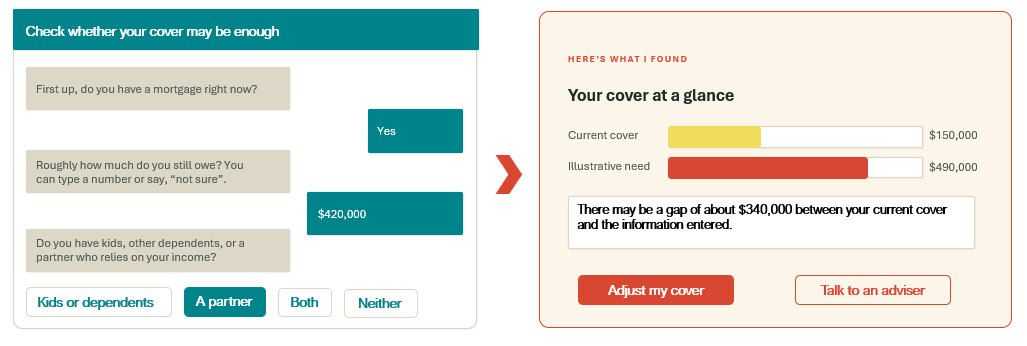
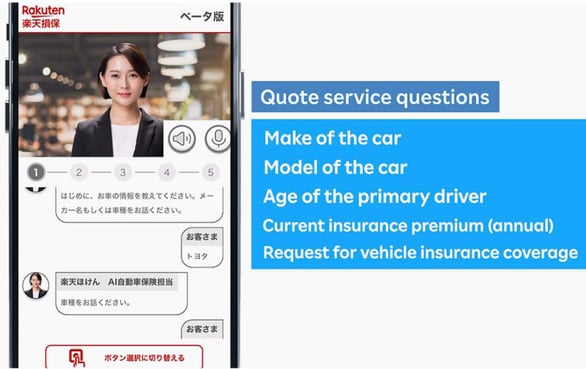
There is also scope to make these tools more engaging. Rakuten, a Japanese technology conglomerate that has a financial services business, created an AI Avatar agent to support people through the motor vehicle insurance quote process online - with the aim of making the process friendlier and easier to engage with (19). Customers can answer questions verbally or type responses in a conversational format, with human-like gestures and synchronised mouth movements from the avatar for a more realistic, conversation-based communication (19). The result was a 34% year-on-year increase in sales (19), demonstrating the value of making tools more human and less transactional.
Adapted from content in (18)
Member Communication
With the Government announcing reforms to allow targeted superannuation prompts as ‘soon as possible’ (18), there is significant opportunity for funds to improve engagement of members with their insurance in the not-too-distant future.
The EAST Framework provides clear guidance on how to shape member communications to elicit engagement. Key principles for reform to member communication should include:
-
Personalised and timely communication – so that members are more receptive to acting on it.
-
Reducing friction/ making it easy – so that minimal effort is required for members to make a decision and execute.
-
Providing education – so that members understand the reason they need to make a decision and the support available.
Method of communication is important – with consideration given to whether time-critical prompts should be delivered by app-based push notifications, or whether personalised email communication would be effective. For vulnerable members funds should consider how best to engage given their circumstances.
Targeted Communication to Improve Engagement
The below image demonstrates how funds can use triggers from existing member data to provide targeted and personalised member communications in a timely manner, to engage members with their insurance and educate them about key decisions.
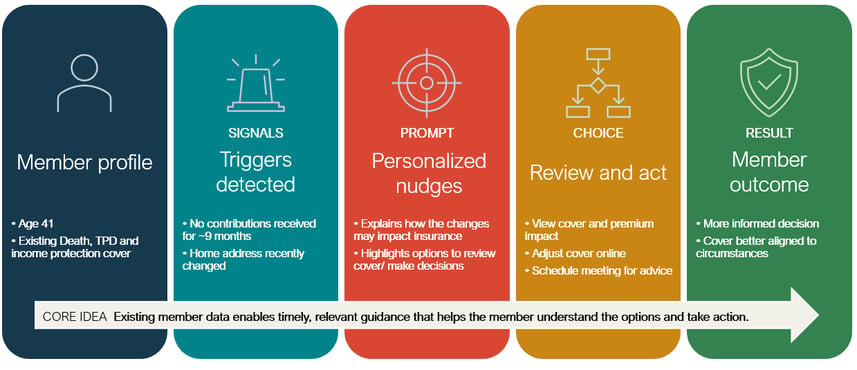
Examples of decisions/alerts for member consideration in relation to their insurance include:
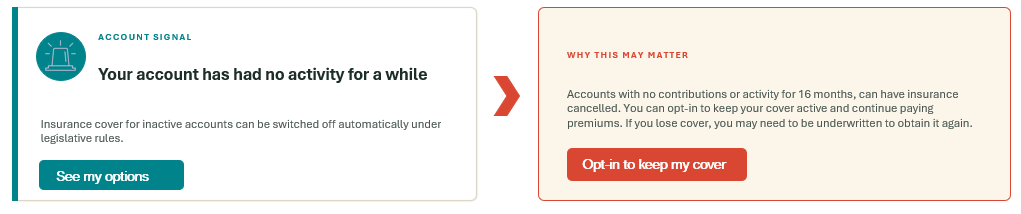
- Inactivity - flagged with the member through a push notification to mobile or an email - takes them to their member portal to explain the activity or decision they need to consider (i.e. opt-in to keep cover) and the implications of their decision. A simple opt-in button should be available to reduce friction.
-
A change of address or increase in SG contribution could flag to the member to review their insurance arrangements at the right time - when changes may be occurring (e.g. pay rise or purchase of property). Rather than this being an afterthought and missing a window for altering their insurance without full underwriting – it becomes a reminder of a key decision in a timely manner.

Ecosystem Integration
This third reform may be a bigger picture opportunity to achieve ‘Omotenashi’ - the Japanese concept of ‘Ultimate Service’ - which involves anticipating a customer’s needs before they are spoken.
Integration across the group insurance ecosystem would enable a real-time member view of interactions with the fund, insurer, and administrator. With integration, AI-driven tools can:
-
Analyse policy and disclosure documents in real-time to support conversations with members about their cover, providing real-time scripting for call centre employees and other relevant stakeholders discussing insurance with the member.
-
A self-serve member-facing AI tool to simplify complexity could also be considered – with analysis of common member questions flagging clarifications required to disclosure documents.
-
-
Analyse calls and correspondence with members to identify member needs and current situation so that when they contact the fund any employee can personalise the conversation with the member and meet them where they’re at.
-
Support cross-partner workflow item creation– reassuring the member that the right person would contact them and have the history of their question to support.
Conclusion
Group insurance is an important safety net for Australians – and while members generally have an awareness that they have cover and understand the value (6), 1 in 3 don’t understand the cover they have (2). Legislative settings around advice currently give little support to funds to meet trustee obligations to explain group insurance to their members and render member communications ineffective. The good news is that legislative reform is on the horizon, which will create opportunities for funds to address the engagement gap – equipping members with what they need to pull the ripcord with confidence.
Written by Elizabeth Haddow-Allen - TAL
References:
-
Maddock, L. (2026, July 20). Insurers pay out $6 billion through group super, but awareness gap persists: CALI. Investment Magazine. https://www.investmentmagazine.com.au/2026/07/insurers-pay-out-6-billion-through-group-super-but-awareness-gap-persists-cali/
-
CALI. (n.d.). Our Dashboards – Life Insurance Sentiment Tracker. Council of Australian Life Insurers. https://cali.org.au/dashboards/
-
Association of Superannuation Funds of Australia. (2025, March 4). Protecting those who would fall through the net: New research reveals 6 million extra Australians are protected by insurance through superannuation. ASFA. https://www.superannuation.asn.au/media-release/protecting-those-who-would-fall-through-the-net-new-research-reveals-6-million-extra-australians-are-protected-from-insurance-through-superannuation/
-
Herbert., B. (2026, May 6). More than 8 million people access income support including sick leave, driven by a growing number of mental health claims. ABC News. https://www.abc.net.au/news/2026-05-06/income-support-grows-mental-health-work/106626692
-
The Actuaries Institute. (2025). The value of group insurance in superannuation: Utilisation. Actuaries Digital. https://www.actuaries.asn.au/research-analysis/the-value-of-group-insurance-in-superannuation-utilisation
-
TAL. (2026). Making insurance matter: How super funds can help their members build financial confidence. TAL Life Limited. https://www.grouphq.tal.com.au/industry-leadership-and-insights/research-papers
-
Super Consumers Australia. (2025, March 27). 1 in 4 Australians are in the dark about the insurance in their super. Super Consumers Australia. https://superconsumers.com.au/research/pulse-spotlight/
-
Australian Securities and Investments Commission. (2023). Report 760: Insurance in superannuation: Industry progress on delivering better outcomes for members. ASIC. https://download.asic.gov.au/media/smpp02v3/rep760-published-22-march-2023.pdf
-
Australian Securities and Investments Commission. (2020). Report 673: Consumer engagement in insurance in super. ASIC. https://www.asic.gov.au/regulatory-resources/find-a-document/reports/rep-673-consumer-engagement-in-insurance-in-super/
-
Hanewald, K., & Huang, F. (2025, November 18). One size doesn't fit all: Is the super system failing vulnerable members? UNSW BusinessThink. https://www.businessthink.unsw.edu.au/articles/superannuation-system-vulnerable-members-retirement-inequality
-
Financial Services Council. (2021, September 15). Guidance Note No. 41: Developing a vulnerable member policy. FSC. FSC Guidance Notes - Financial Services Council
-
Australian Securities and Investments Commission. (2012). Regulatory Guide 244: Giving information, general advice and scaled advice. ASIC. https://asic.gov.au/regulatory-resources/find-a-document/regulatory-guides/rg-244-giving-information-general-advice-and-scaled-advice/Australian Securities and Investments Commission. (2019). Giving and collectively charging for intra-fund advice. ASIC. https://www.asic.gov.au/regulatory-resources/superannuation-funds/superannuation-guidance-relief-and-legislative-instruments/giving-and-collectively-charging-for-intra-fund-advice/
-
Taylor, M. (2026, March 20). FAAA demands recognition of adviser skill shortage [Media release]. Financial Newswire. https://financialnewswire.com.au/financial-planning/faaa-demands-recognition-of-adviser-skill-shortage/
-
Pilat, D., & Krastev, S. (2021). The COM-B model for behavior change. The Decision Lab. https://thedecisionlab.com/reference-guide/organizational-behavior/the-com-b-model-for-behavior-change
-
Fox, J. (2026). Simplifying behaviour change with the EAST framework. Orlo. https://orlo.tech/blog/simplifying-behaviour-change-with-the-east-framework/
-
Money Management. (2026, August 19). Mulino shares major DBFO progression on advice reform. Money Management. https://www.moneymanagement.com.au/mulino-shares-major-dbfo-progression-on-advice-reform/
-
Treasury. (2026, August). Protecting consumers and the promise of superannuation in an evolving financial ecosystem [Fact sheet]. Australian Government. https://treasury.gov.au/sites/default/files/2026-08/p2026-797028-npc-fact-sheet.docx
-
Rakuten Group, Inc. (2025). Industry first! Rakuten General Insurance launches AI Avatar into auto insurance estimation service. Rakuten Group. https://global.rakuten.com/corp/innovation/rnn/2025/2505_012/