
A Fire, Not Smoke
Who pays for TPD, why the case we’re making isn’t winning, and how to win
Introduction: Fire Marks
Eighteenth century London insured against fire through private offices that ran and paid for their own
brigades. Each building bore a metal plaque, a Fire Mark, to show which office insured it.1

On 22 June 1861, a fire began at Cotton’s Wharf and burned a quarter mile of the Thames.2 Cotton’s
Wharf was insured and rated as well protected. James Braidwood, who ran the insurers’ brigade, was
killed by a falling wall. His men bravely fought fires regardless of which office bore the Fire Mark, because fire doesn’t read plaques.3 First the uninsured building would burn, then the insured building next to it.
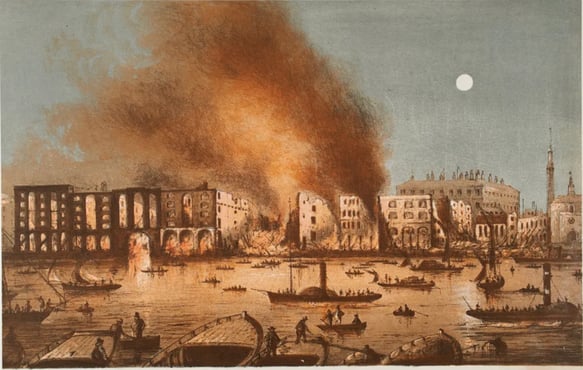
Parliament’s answer was the Metropolitan Fire Brigade Act 1865.4 They won it with a fire, not smoke.
The Australian life insurance industry is currently having its 1862 moment.
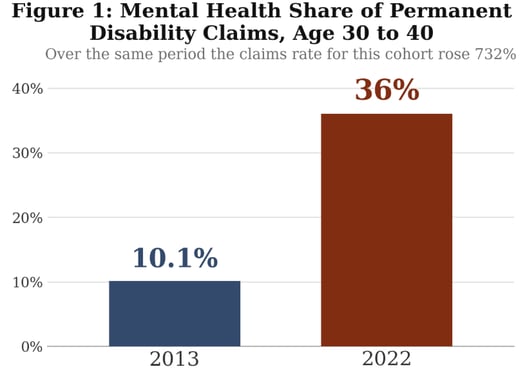
Is Total and Permanent Disability (TPD) sustainable in its current form? No. Mental health is now the
primary cause of TPD claims at close to one in three paid.5 The permanent disability claims rate in the
30-40 cohort has risen 732% from 2013 to 2022 on retail life insurance data.6
Separately, the Disability Support Pension (DSP) has been narrowing since the 2012 impairment
tables and recipients as a percentage of the working population has decreased to levels last seen in the 1990’s.7 Both safety nets are closing at once, with rates of new DSP grants due to psychological
conditions also increasing.8
Who pays? Mainly the consumer, and beyond that the government. On the data the industry publishes, it’s difficult to make that case to Treasury. That gap is the reason for this essay.
Chapter One: IDII and the fire next door
The usual explanation of the IDII intervention has a regulator forcing an unwilling market to fix a
product on which it had lost $3.4 billion in five years.9
That account has the mechanism backwards. APRA itself records that insurers would not move first
because redesign meant cutting benefits or raising prices, or both.10 APRA imposed a Pillar 2 capital
charge on every insurer with IDII exposure at once, effective 31 March 2020, and set common
commencement dates for the product changes. Nobody moved first because everybody moved
together. APRA did not compel a change the industry resisted, it removed the penalty for making one the industry already wanted.11 IP then became smaller, more expensive and held by fewer
Australians.12
TPD and the DSP overlap and it isn’t by design. A person who meets a TPD definition likely also
qualifies for the DSP. TPD lump sums are not offset against DSP, although a TPD lump sum is
assessable under the Social Security Act assets and income tests once released from superannuation.13
A group TPD benefit is paid into superannuation, which is exempt from the assets test and from
deeming until Age Pension age. A hypothetical 35 year old who receives a $400,000 payment and
leaves it there keeps the DSP in full. If they release it on permanent incapacity grounds it is assessed.
If they apply it to the mortgage, the home is exempt and the DSP resumes. This sequence wasn’t
designed, and it hasn’t been measured. If staged benefits were expanded, specifying how they interact with the DSP sharpens the case to Treasury and demonstrates the fire.
Chapter Two: Raising the premium on timber
After the Cotton’s Wharf fire, offices raised riverside mercantile rates by up to 300% and demanded
better subdivision of risk.14 The merchants revolted, and founded the Commercial Union to
underwrite the same risks at lower rates. Only then, in 1862, did the offices write to the Home
Secretary to say they could no longer accept responsibility for London’s fire safety.15 They tried our
version of raising premiums and shifting cost, and it didn't work.
Now in the 2026 Australian life insurance industry, the APRA and ASIC roundtable noted that
changes in claim patterns are usually managed through premium increases and reduced cover rather
than product redesign.16
So, which levers reduce cost and which merely shift it?
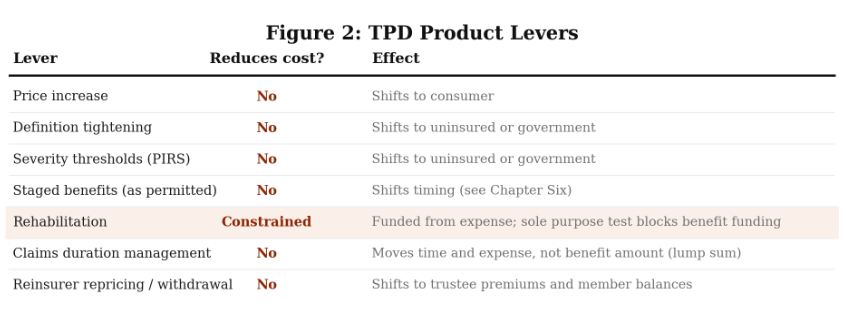
Price shifts cost to the consumer,17 so does definition tightening18 and percentage based severity
thresholds such as PIRS narrow eligibility.19 Staged benefits, as currently permitted by law, shift
timing. Claims duration management reduces cost where it funds recovery and shifts timing where it
doesn’t.
Insurers fund rehabilitation from expense and the sole purpose test doesn’t allow a benefit to fund a
member’s treatment.20 It is difficult to rehabilitate someone whose entitlement relies on being unrehabilitable.
One exception is rehabilitation on IP claims, which reduces IP to TPD conversion.
Reinsurer caution shifts cost since withdrawn capacity or repricing flows through to trustee premiums.
In October 2025, Swiss Re paused new business in Australia, saying it wouldn’t seek new life clients
until the market demonstrated a clear shift towards sustainable TPD product design.21 A reinsurer has
already made an 1862 move.
The drivers are demographic, economic, definitional and behavioural. KPMG notes a 732% increase
in permanent disability claims rates for the age 30-40 cohort from 2013 to 2022, with 36% of that
cohort’s claims related to mental health.22 The group pool shrinks as premiums rise and reinsurers
reprice.23 Permanence based definitions are hard to apply to mental health.24 KPMG found mental
health claims growing at 8.8% a year against 0.6% for physical causes.25
Of these, the definitional and behavioural drivers dominate. KPMG attributes 79.6% of the decade’s
rise in TPD claims to mental health, which permanence based definitions were never designed to assess.26 Demographic and economic pressure are secondary, they thin the premium base and amplify the primary definitional and behavioural drivers.
Who bears the cost?
The consumer largely bears it due to higher premiums, typically deducted from compounding
retirement balances.27 The Australians who fall outside cover bear it through lost benefits. The
government also bears it, due to a heavier reliance on DSP and other income support for those who
qualify, however the data to measure this hasn’t been published.
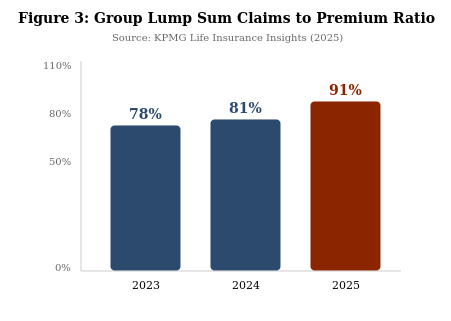
The Group lump sum claims to premium ratio increased from 78% in 2023 to 91% to 30 June 2025.28
One fund recently increased TPD premiums 40% for roughly 1.7 million insured members.29 In
Group, the 2019 default cover changes left roughly 11,000 Australians each year outside of cover who
would have received TPD benefits, forgoing an estimated $1.5 billion in benefits annually.30 Each
correction muddies the pool, and there is little margin left, with Group superannuation TPD paying
out 99% of premiums in claims in the twelve months to December 2025.31
Chapter Three: How we have described the fire
CALI notes that life insurance is a part of Australia’s safety net32, and in its January 2026 budget
submission explained that mental health permanent disability claims costs increased by $169.2
million, or 433%, between 2014 and 2022.33
The Productivity Commission recommended a review in 201834, and Super Consumers Australia
noted that recommendation remained active seven years later.35 The industry wants a review.
Consumer advocates want a review. Now eight years later, no review.
The Royal Commission explained that disclosure aimed at people who can’t act on it fails,36 however
this is evidence aimed at the one party who can act, Treasury. What a review should outline is what
we have stopped paying, to who, at what rate, where those people went instead, and what financial
burden this placed on Social Services. We must describe a fire to a government who can only see
smoke.
Chapter Four: What numbers to attach to the fire
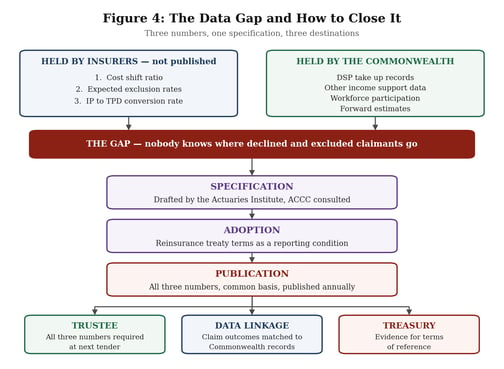
The cost shift ratio.
The cost shift ratio is the share of a change’s projected savings that comes from excluding people who remain disabled.
Any change that narrows cover should be published as the projected saving set against the reduced
incidence and duration of disability, so that the transferred loss is visible. Insurers already hold this
data. A pricing basis for a definition change is not actuarially sound unless it separates the eligibility
effect from the morbidity effect. That analysis already exists wherever a change has been priced, so
the cost is publication, not production.
Expected exclusion rates.
Once a Policy or Endorsement takes effect, an estimated exclusion rate should be published annually.
This sits within Peter Kell’s recommendation that cover limiting features be supported by actuarial or
statistical evidence and reviewed every three years.37
The objection is obvious, publishing exclusion rates hands plaintiff firms and journalists a stick. But
the number exists whether we publish it or not, the only question is who produces it and in what
context. The alternative is the same figures arriving through a regulator’s dataset or a Royal
Commission, with us explaining why we sat on it. It’s better to have the stick in our own hands.
Income Protection to TPD Conversion Rate.
The proportion of IP claims converting to TPD, split by whether the insurer funded rehabilitation. It
measures the only lever we hold that doesn’t shift cost.
A Data Linkage Study
We don’t know where declined and excluded claimants go. The Government records through social
security and workforce data that fewer Australians are reaching the DSP.38 The Parliamentary Budget
Office noted in 2018 that recipients as a share of the working age population have returned to late
1990’s levels,39 with mental health conditions the most common primary condition for DSP recipients
aged 16-64 at 42%.40 Both systems are carrying the same problem and neither can see the other’s
numbers.
A data linkage study linking claim outcomes to subsequent DSP take-up, other income support and
return to work would replace assumptions the industry has held since 2018 with evidence.
CALI is the natural sponsor, with the Actuaries Institute as an analytical partner. In December 2025
the ABS and PLIDA Board endorsed the National Insurance Dataset for home, contents and strata
cover, linking data to Commonwealth records under the Privacy Act 1988 to study insurance
affordability.41 Centrelink data, ATO and single touch payroll income, NDIS and PBS already sit
inside the PLIDA.42 The Board endorsed scoping private sector access where projects show clear
public benefit, with Treasury as an observer.
Co-ordination Mechanisms.
How do we co-ordinate publication when the Code won’t compel? Kell supported contractual
enforceability but deferred it to the next Code review in five years.43 The Insurance in Superannuation Voluntary Code failed because the viewer couldn’t tell who was complying.44 Standard 27 held
because it produced a verifiable standard, and that is what this is.45
APRA and ASIC indicated a willingness to facilitate joint insurer and trustee effort to drive better
outcomes for members.46 The Actuaries Institute could draft the specification in a facilitated forum,
with the ACCC consulted, as Standard 27 was. On IDII, APRA convened a similar arrangement, with
an Actuaries Institute task force setting common data expectations.47
Reinsurance treaties already require reinsurer consent for material policy changes, and the exclusion
estimate is produced internally to support that, so publication adds no substantial cost. Comparability
is what makes sustainable design sellable. Data specification adopted through reinsurer treaty terms
sets a collective reporting condition rather than a price and raises the same competition law question
Standard 27 did.48 A trustee can then require all or some of the above mentioned data metrics in its
next tender.49
Chapter Five: What a sustainable TPD product that commands public trust looks like
Following the Metropolitan Fire Brigade Act of 1865, the fire offices were required to pay 35 pounds
per 1 million pounds of gross sums insured on a quarterly basis alongside a halfpenny rate on
ratepayers and a 10,000 pound Treasury grant.50 This was an example of the private and public cost
boundaries being specified via statute.
Braidwood’s men earned public trust by fighting every fire, regardless of the Fire Mark. A TPD
product commands the same trust only when it can demonstrate who it turns out for and who it leaves in the smoke on a published basis.
Sustainability depends on where the divide between private and public disability support is.
There is international precedent. The Netherlands specifies the boundary via statute. Employers carry
the first 104 weeks of incapacity. The state then carries the risk, but only above a 35% loss of earning
capacity, and the statute separates permanent and full incapacity (IVA) from partial or temporary
incapacity (WGA). Employers can opt out of the WGA as own risk bearers and insure it privately. A
severity threshold, a permanence split and a defined private layer is all legislated.51
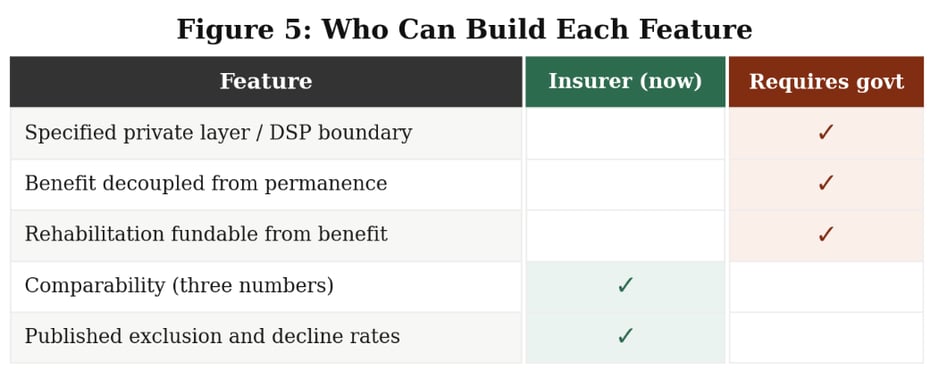
A benefit decoupled from permanence and delivered in stages is ideal. Normal TPD entitlement is
conditioned on being unrehabilitable. A staged benefit removes that barrier and asks whether the
disability persists, and later stages can be reduced if it doesn’t. Going further would require amending
s 62 of the SIS Act and reg 6.01 of the SIS Regulations.
The staged benefits currently permitted by law shift timing (Figure 2). The future version that
removes the permanence condition, which changes outcomes rather than sequencing, is what requires s 62 amendment.
A benefit triggered at three months by functional impairment, funding rehabilitation from the benefit
rather than from expense, and reassessed at twelve months, does what a lump sum conditioned on
permanence can’t. Insurers have created regulatorily constrained versions of this, but the roundtable
records that take up remains low.52
This analysis primarily concerns Group superannuation, where the trustee lever applies. Retail requires separate treatment however advisers would likely appreciate this information too.
Chapter Six: What to submit
A regulated industry that pleads a self interested case is partially discounted at the door. What
Treasury doesn’t discount is its own forward estimates, and this is the reason for the data linkage
study. Australia should legislate the boundary, as the Netherlands has.53
Commission the study, then seek terms of reference for a review. Productivity Commission inquiries
need the Treasurer to issue this. Separately, a Senate Economics References Committee inquiry needs
the Senate to refer it. The review should address 4 questions:
-
What share of national disability risk insurers should carry, and where the boundary with DSP
and Social Support sits now and should sit later;
-
Whether the 2019 default cover settings should be recalibrated now that their effects are
observable rather than projected;
-
Whether the condition of release should permit staged benefits; and
-
Whether the sole purpose test should permit the funding of treatment from an insured benefit.
The latter two would give the industry’s pen the ink to write sustainable products.
Conclusion
The fire offices didn’t solve their problem by raising the premium on timber, although at first they
tried. They went to Parliament with an observable fire and an economic loss attached to it. They used
their collective pen to show they could not fix it alone and what came back was a Parliamentary Act.
We can improve our TPD product, but not to the point of sustainability within its current constraints.
To enable structural reform, we must demonstrate the effect this has on Treasury’s disability payment
system.
Our alternative is to keep repricing, keep redefining, keep reimagining, until default TPD cover
becomes economically unviable, opt in participation increasingly selects for the already unwell, and
trustees can no longer recommend cover under their best financial interests duty.
Give Treasury a burnt quarter mile of the Thames and a set of numbers that demonstrates how much
the cost shift ratio burns them. That is how we win our case, and how we make TPD sustainable. We
have the brigade to do it.
Written by Jack Jones - TAL
Footnotes
- London Fire Brigade Museum, Early Fire Brigades and the London Fire Engine Establishment.
- George Robb, ‘The Great Tooley Street Fire of 1861’ (2011) 36(2) The London Journal.
- Select Committee on the Protection of Life and Property against Fire in the Metropolis, Report (House of Commons Paper, 1862).
- Metropolitan Fire Brigade Act 1865 (28 & 29 Vict c 90).
- Council of Australian Life Insurers and KPMG, Data Collection Cause of Claims Results Report H2 2024 (Report, 30 May 2025), reported in Council of Australian Life Insurers, ‘Mental Ill Health Is Straining Australia’s Safety Net’ (Media Release, July 2025) https://cali.org.au/mental-ill-health-isstraining-australias-safety-net/.
- KPMG, Australia’s Mental Health Check Up: Council of Australian Life Insurers and KPMG Life Insurance Industry Data Collection 2013 - 2022 (Report, November 2024) 18-22.
- Parliamentary Budget Office, Disability Support Pension: Historical and Projected Trends (Report No 01/2018, 20 February 2018) vi, 12.
- Parliamentary Budget Office (n 7) vi, 18.
- APRA, 'Is IDII back on track?’(Media Release, 16 December 2022) https://www.apra.gov.au/newsand-publications/idii-back-track.
- Ibid.
- APRA, Sustainability Measures for Individual Disability Income Insurance (Letter to All Life Insurers and Friendly Societies, 2 December 2019).
- APRA (n 9); KPMG, Life Insurance Insights (n 23).
- Social Security Act 1991 (Cth).
- Robb (n 2).
- Select Committee (n 3).
- APRA and ASIC, Life Insurance CEO roundtable, April 2026, public notes (held 15 April 2026).
- AustralianSuper, Important Changes to Insurance Costs (Significant Event Notice, March 2026).
- Financial Services Council, Standard No.27: Removal of Occupational Exclusions and Occupation Based Restrictive Disability Definitions in Default Cover (effective 1 January 2023).
- State Insurance Regulatory Authority (NSW), Guidelines for the Evaluation of Permanent Impairment, Chapter 11 (Psychiatric Impairment Rating Scale).
- Superannuation Industry (Supervision) Act 1993 (Cth) s 62; Superannuation Industry (Supervision) Regulations 1994 (Cth) reg 6.01.
- Swiss Re, ‘Swiss Re Life & Health Australia to Pause New Business’ (Media Release, October 2025), reported in ‘Swiss Re “Pauses” New Business Activities’, riskinfo (23 October 2025) https://riskinfo.com.au/news/2025/10/23/swiss-re-pauses-new-business-activities/.
- KPMG, Mental Health Check Up (n 6).
- KPMG, Life Insurance Insights 2025 (Report, 2025).
- Peter Kell, Independent Review of the Life Insurance Code of Practice (Final Report, 30 June 2026).
- KPMG, Mental Health Check Up (n 6)
- KPMG, Mental Health Check Up (n 6)
- AustralianSuper (n 17).
- KPMG, Life Insurance Insights (n 23).
- AustralianSuper (n 17).
- Association of Superannuation Funds of Australia, Spotlight on Insurance (Research Report, March 2026).
- APRA and ASIC, Life Insurance Claims and Disputes Statistics, 12 months to 31 December 2025.
- Council of Australian Life Insurers, Life Insurance Code of Practice (March 2025).
- Council of Australian Life Insurers, Pre-Budget Submission 2026-27 (30 January 2026).
- Productivity Commission, Superannuation: Assessing Efficiency and Competitiveness (Inquiry Report No 91, 21 December 2018).
- Super Consumers Australia, media statement of Xavier O’Halloran, Director (21 July 2025).
- Royal Commission into Misconduct in the Banking, Superannuation and Financial Services Industry, Final Report (2019), vol 1, ch 4.4, pp 275-278.
- Kell (n 24).
- Department of Social Services, DSS Payment Demographic Data (Dataset, data.gov.au).
- Parliamentary Budget Office (n 7) vi, 12.
- Australian Institute of Health and Welfare, ‘Income Support Payments for the Working Age Population’, Australia’s Welfare (Web Report, 16 October 2025) https://www.aihw.gov.au/reports/australias-welfare/income-support-payments-for-the-working-age-popula.
- Australian Bureau of Statistics, ‘PLIDA Data and Legislation’ (Web Page) https://www.abs.gov.au/statistics/data-integration/integrated-data/person-level-integrated-data-asset-plida/plida-data-andlegislation.
- Australian Bureau of Statistics, ‘PLIDA Board’ (Web Page) https://www.abs.gov.au/statistics/dataintegration/integrated-data/person-level-integrated-data-asset-plida/plida-board, meeting summary 24 March 2026 and Membership.
- Kell (n 24).
- Insurance in Superannuation Working Group, Insurance in Superannuation Voluntary Code of Practice (December 2017) (discontinued).
- Financial Services Council (n 18).
- APRA and ASIC (n 16).
- APRA (n 11) 1-2, Attachment C.
- Financial Services Council (n 18).
- Superannuation Industry (Supervision) Act 1993 (Cth) s 52(7)(a)-(c), s 52(11)(c)-(d).
- Metropolitan Fire Brigade Act 1865 (n 4) s 13.
- Wet werk en inkomen naar arbeidsvermogen [Work and Income (Capacity for Work) Act (Netherlands) 2005.
- APRA and ASIC (n 16).
- Wet werk en inkomen naar arbeidsvermogen (n 51).
Bibliography:
A) Articles, Books and Reports
-
Association of Superannuation Funds of Australia, Spotlight on Insurance (Research Report,
March 2026)
-
Australian Bureau of Statistics, ‘PLIDA Board’ (Web Page) https://www.abs.gov.au/statistics/dataintegration/
integrated-data/person-level-integrated-data-asset-plida/plida-board, meeting summary
24 March 2026 and Membership
-
Australian Bureau of Statistics, ‘PLIDA Data and Legislation’ (Web Page) https://www.abs.gov.au/
statistics/data-integration/integrated-data/person-level-integrated-data-asset-plida/plida-data-and legislation
-
Australian Institute of Health and Welfare, ‘Income Support Payments for the Working Age
Population’, Australia’s Welfare (Web Report, 16 October 2025)
-
Australian Prudential Regulation Authority, ‘Is IDII Back on Track?’ (Media Release, 16
December 2022) https://www.apra.gov.au/news-and-publications/idii-back-track
-
Australian Prudential Regulation Authority, Sustainability Measures for Individual Disability
Income Insurance (Letter to All Life Insurers and Friendly Societies, 2 December 2019)
-
Australian Prudential Regulation Authority and Australian Securities and Investments
Commission, Life Insurance CEO Roundtable (Communique, 15 April 2026)
-
Australian Prudential Regulation Authority and Australian Securities and Investments
Commission, Life Insurance Claims and Disputes Statistics (Statistical Publication, 12 months to
31 December 2025)
-
AustralianSuper, Important Changes to Insurance Costs (Significant Event Notice, March 2026)
-
Council of Australian Life Insurers, Life Insurance Code of Practice (March 2025)
-
Council of Australian Life Insurers, Pre-Budget Submission 2026-27 (30 January 2026)
-
Council of Australian Life Insurers and KPMG, Data Collection Cause of Claims Results Report
H2 2024 (Report, 30 May 2025)
-
Department of Social Services, DSS Payment Demographic Data (Dataset)
-
Financial Services Council, Standard No 27: Removal of Occupational Exclusions and
Occupation-Based Restrictive Disability Definitions in Default Cover (effective 1 January 2023)
-
Insurance in Superannuation Working Group, Insurance in Superannuation Voluntary Code of
Practice (December 2017)
-
Kell, Peter, Independent Review of the Life Insurance Code of Practice (Final Report, 30 June
2026)
-
KPMG, Australia’s Mental Health Check Up: Council of Australian Life Insurers and KPMG Life
Insurance Industry Data Collection 2013-2022 (Report, November 2024)
-
KPMG, Life Insurance Insights 2025 (Report, 2025)
-
London Fire Brigade Museum, ‘Early Fire Brigades and the London Fire Engine Establishment’
(Web Page)
-
Parliamentary Budget Office, Disability Support Pension: Historical and Projected Trends (Report
No 01/2018, 20 February 2018)
-
Productivity Commission, Superannuation: Assessing Efficiency and Competitiveness (Inquiry
Report No 91, 21 December 2018)
-
Robb, George, ‘The Great Tooley Street Fire of 1861’ (2011) 36(2) The London Journal
-
Royal Commission into Misconduct in the Banking, Superannuation and Financial Services
Industry (Final Report, February 2019)
-
Select Committee on the Protection of Life and Property against Fire in the Metropolis, Report
(House of Commons Paper, 1862)
-
State Insurance Regulatory Authority (NSW), Guidelines for the Evaluation of Permanent
Impairment
-
Super Consumers Australia, ‘Statement of Xavier O’Halloran, Director’ (Media Statement, 21 July
2025)
-
Swiss Re, ‘Swiss Re Life & Health Australia to Pause New Business’ (Media Release, October
2025)
B) Legilsations
-
Metropolitan Fire Brigade Act 1865, 28 & 29 Vict, c 90
-
Privacy Act 1988 (Cth)
-
Social Security Act 1991 (Cth)
-
Superannuation Industry (Supervision) Act 1993 (Cth)
-
Superannuation Industry (Supervision) Regulations 1994 (Cth)
-
Wet werk en inkomen naar arbeidsvermogen [Work and Income (Capacity for Work) Act] 2005
(Netherlands)