
Q6. RATING THE UNRATABLE? DO PIRS AND IMPAIRMENT SCALES HAVE A PLACE IN LIFE INSURANCE?
Introduction
Total and Permanent Disability (TPD) insurance asks a seemingly straightforward question. Does injury or illness permanently impair a person’s capacity to work? In the context of mental health conditions, however, that question has proven increasingly difficult to answer. Symptoms fluctuate, objective diagnostic markers are limited and claims assessment is reliant on disparate and sometimes conflicting medical evidence. The impact of this challenge is considerable.1
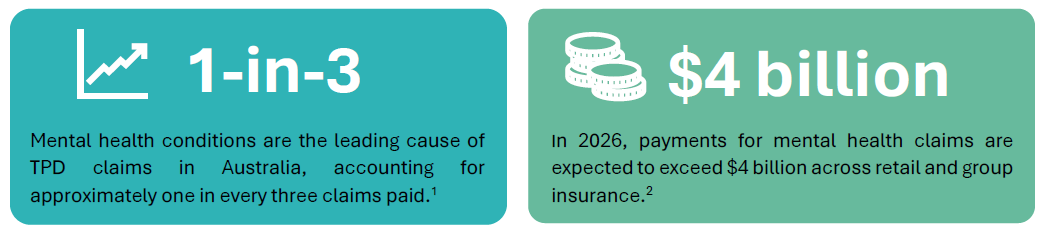
With mental health claims at unprecedented levels, the traditional TPD framework is being stretched, and its suitability tested.3 This is prompting life insurers to look at non-traditional solutions. One such solution is the use of severity-based products that incorporate impairment rating scales. Extensively used within statutory compensation schemes, impairment scales provide a structured framework purported to enable more objective and consistent claims assessment. However, does the fact that an assessment framework works effectively in one compensation setting necessarily mean it is appropriate for another?
This paper explores that question. It examines the strengths and limitations of impairment scales and concludes that these tools can have a legitimate place in TPD. Within the current framework that role is not to determine entitlement, but instead to structure and triage mental health claim assessments. However, looking ahead their most useful application may be found in enabling graduated forms of TPD that better reflect the spectrum of mental health disability.
Impairment scales are useful tools…
Impairment scales are a common feature of Australian statutory compensation schemes. Most workers compensation, motor accident compensation and social security systems utilise some form of rating methodology to assist in determining eligibility for benefits and, in some cases, the amount of compensation payable.4
Most impairment scales used in Australia derive from the American Medical Association Guides to the Evaluation of Permanent Impairment (AMA Guides).5 First published in 1966, the AMA Guides are widely regarded as the most authoritative and influential framework for measuring impairment. The approach to assessing psychiatric impairment within the AMA Guides has evolved substantially over successive editions. Australian impairment scales reflect this evolution, adopting differing methods to rate impairment.6 Broadly, however, most fall into one of two categories:
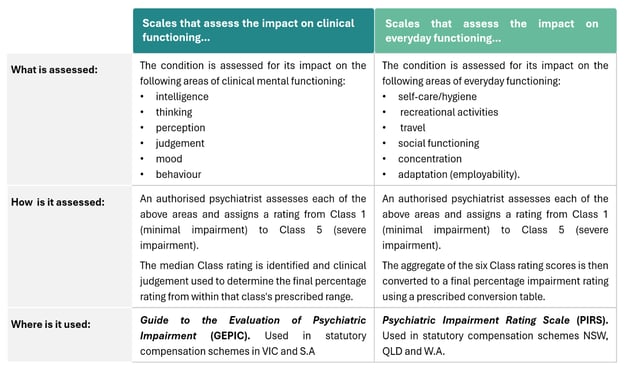
Although the way in which they measure impairment differs, the essential purpose of all impairment scales is the same. They aim to provide a reliable and repeatable assessment framework.7 This standardisation offers several benefits when it comes to benefit decision-making:
Objectivity: Assessment of mental health conditions is inherently subjective. Outcomes may vary according to how a claimant describes their symptoms and/or how the assessor interprets them. By requiring assessments to be made against defined criteria and translated into a numerical result using a prescribed methodology, impairment scales limit the scope for individual discretion. This produces greater standardisation, and ostensibly, greater objectivity, in both medical opinions and the claim decisions that rely on those opinions.8
Consistency: A common assessment framework helps reduce variation between experts. A review of assessments carried out under a prescribed Australian framework found a substantial degree of consistency between independent psychiatrists assessing the same claimant.9 This improves fairness for both claimants and insurers because outcomes do not depend on the individual assessor involved.
Transparency: Impairment scales provide an additional level of clarity about a claimant’s condition. Assessors are generally required to document the rationale for their rating on each domain by reference to observed symptoms, reported functioning and information obtained from relevant third parties (such as treating practitioners).10 The resulting report provides insurers with a much clearer evidentiary foundation upon which to base their decisions.
Certainty: Linking claims decisions to a structured and transparent assessment methodology makes it easier for claimants to understand how those decisions have been reached. This can promote greater acceptance of claim decisions and help to reduce disputes. Most scales also require that maximum medical improvement (MMI)11 be obtained before assessment is conducted. This provides insurers with greater certainty that the claim is being evaluated at an appropriate point in the claimant’s recovery.
Built for a different context…
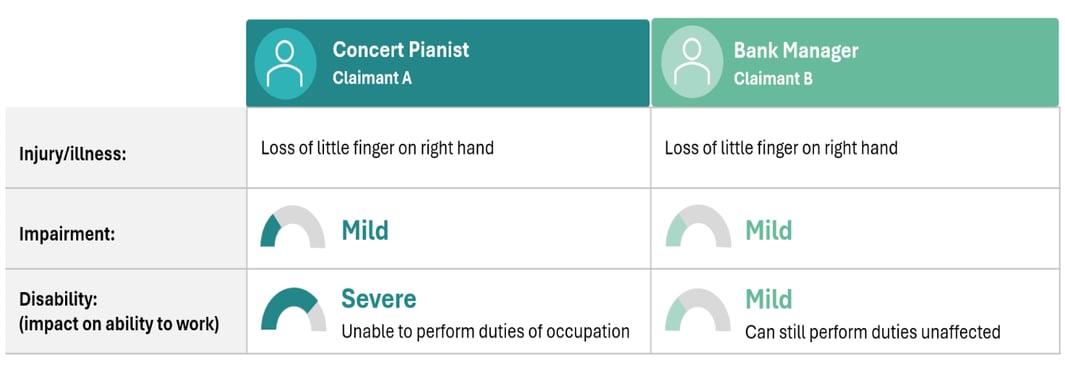
Given these advantages, the use of impairment scales in TPD has an intuitive appeal. However, a method that performs a legitimate role in one compensation setting does not automatically perform the same role in another. Statutory schemes are typically concerned with awarding compensation based on the degree of impairment arising from injury or illness. TPD, by contrast, is concerned with disability. Although the terms are often used interchangeably, it is important to recognise that impairment and disability are not the same thing.
Impairment concerns the severity of a medical condition. Disability concerns the practical consequences of that condition on an individual's functional ability, including their ability to work.12 The danger of incorporating impairment ratings into TPD is that a measure of impairment may gradually become treated as a proxy for disability. In fact, two individuals with identical impairment ratings may experience very different vocational outcomes depending on their occupation, education and personal circumstances. This distinction can be illustrated with the following example:13
It is also important to recognise that within statutory compensation schemes, the use of impairment scales occurs within the context of highly regulated legislative frameworks. The relevant legislation prescribes matters such as when assessments are undertaken, who can perform them, how costs are allocated and the processes for review and dispute resolution. In contrast, life insurance is principally a contractual regime. It should not be assumed that impairment scales can be incorporated into life insurance without some of the same safeguards and governance mechanisms needing to be applied.
But they may have a place in TPD…
Although widely used in statutory compensation schemes, impairment scales presently play a more limited role in life insurance.14 However, as the prevalence of mental health claims continues to increase, insurers may increasingly consider dedicated mental health TPD constructs, for which a severity-based approach may seem an attractive option.15
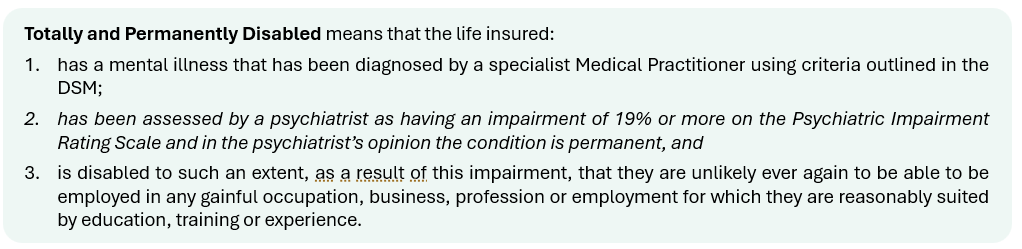
Where impairment scales are used, a threshold level of impairment is typically specified.16 A claimant must satisfy that threshold to qualify for a benefit. However, whether impairment scales should operate as a gateway to entitlement is open to question. First, not all scales consider vocational impairment. Even where it is considered, vocational impairment ordinarily forms only one component of an aggregate score. Consequently, an individual may obtain a high rating because of significant impairment in areas such as self-care or social functioning yet retain a substantial capacity for employment. Conversely, a person may experience severe restrictions in their ability to work but remain ineligible for a TPD benefit due to their aggregate score being below the prescribed impairment threshold.
This disconnect has a familiar feeling. It bears some similarity to the application of activities-of-daily-living (ADL)-based TPD cover.17 In both instances, benefit entitlement depends on measures of impairment that are imperfect proxies for a claimant’s vocational capacity. The use of impairment ratings as determinants of TPD eligibility may therefore attract similar criticisms to those previously directed at ADL-based cover, including that such ratings are misaligned with the underlying purpose of TPD and therefore have no place in its design.18
While their numerical output suggests that impairment methodologies allow for fine distinctions in claimant assessment, differences in ratings may have little practical significance. Assessors must still interpret symptoms and attempt to apply rating criteria based on largely self-reported information. Those judgments remain susceptible to influence from many factors.19 This is particularly problematic where entitlement is determined based on attainment of a specified threshold. For instance, the practical difference between a claimant assessed at 19% impairment and one assessed at 20% may be negligible. The difference may simply reflect the assessor's subjective interpretation of one small aspect of the claimant's presentation on the day of assessment. However, the resulting difference in entitlement is significant if a benefit is only payable at 20%.
If entitlement does depend on reaching a specified impairment score, a claimant’s attention may become focused on demonstrating the limitations necessary to cross that threshold. This concern is not unique to impairment scales. The binary nature of traditional TPD products can also incentivise disability rather than recovery.
However, the issue may become more pronounced where entitlement rests upon satisfying a particular level of reported limitation in certain specified areas of functioning.
Finally, there is a risk that impairment thresholds are set too high. This would limit access to benefits to only a small proportion of claimants.20 Whether intentional or inadvertent, an overly restrictive approach is likely to attract significant consumer criticism, as well as potential regulatory scrutiny.21
Despite these limitations, impairment scales may still have a legitimate role:
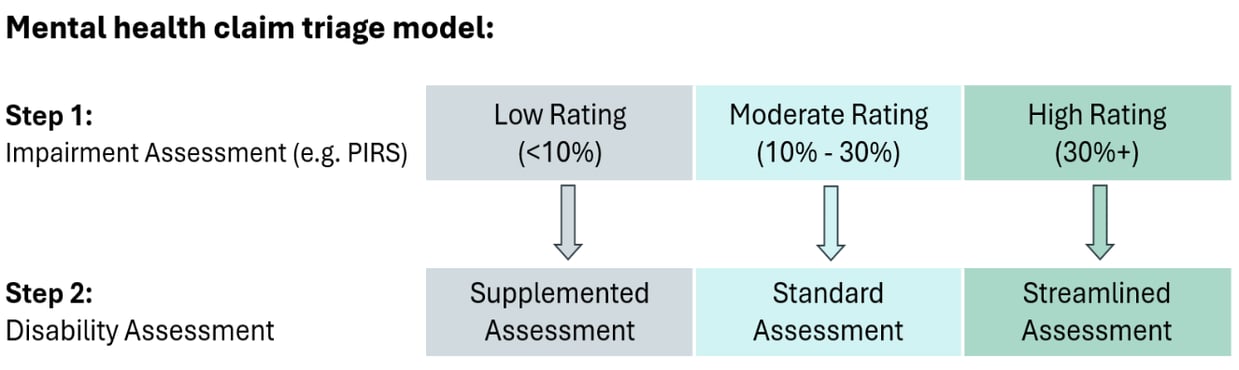
Within the current TPD model: Rather than serving as a threshold test, impairment scales could operate as a claims triage and evidentiary tool. Insurers may still require that a claimant be assessed under a prescribed framework. However, the rating obtained informs the scope of any further investigation required.
Lower ratings would not automatically defeat a claim but would indicate the need to obtain more detailed medical and/or vocational evidence. Conversely, a higher rating could support a streamlined pathway to claim approval. In all cases, the claims professional would retain responsibility for deciding the question of TPD. If sensibly applied, this model could support more proportionate claims investigations and more transparent outcomes for claimants and insurers.
In future forms of TPD design: Mental health disability exists on a spectrum. Many claimants retain some capacity for employment despite experiencing significant functional limitations from time-to-time. Yet traditional TPD products generally force a binary outcome. One option to address this is to incorporate impairment ratings into a graduated benefit design structure, where the degree of impairment influences the nature of support provided.
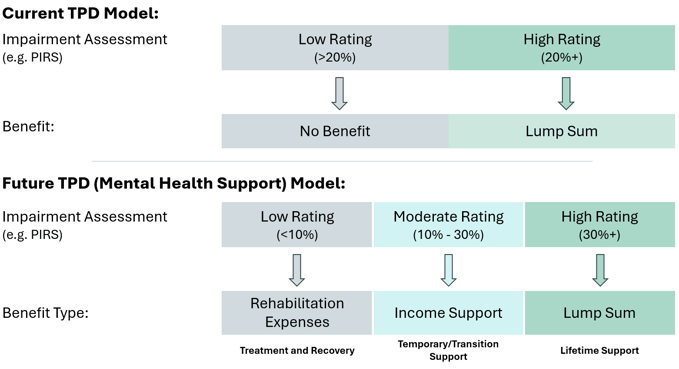
Under this model, the benefit pathway would be influenced by the impairment rating. For example, rehabilitation and/or income support benefits could be provided to claimants assessed to have a lower impairment rating. Lump-sum benefits are reserved for those whose rating establishes a severe and enduring disability. Such an approach could:
• address the limitations of the traditional all-or-nothing TPD design,
• shift claimant focus away from having to attain a particular level of disability (and potentially facilitate rehabilitation within the TPD construct), and
• mitigate the impact of arbitrary rating thresholds (including the risk that eligibility thresholds are set at levels that inappropriately restrict access to benefits).
This would move TPD towards a model that provides support more tailored to need. Also, by limiting the situations in which large lump sum benefits are paid, such a design could potentially contribute to the future long-term sustainability of the product.
If carefully applied…
Regardless of how impairment scales are ultimately used, their incorporation into TPD should be accompanied by appropriate safeguards. Three things are particularly important. There should be transparency regarding the role impairment scales play, consistent industry standards governing their use, and the development of sufficient institutional expertise within insurers to apply and validate impairment assessments correctly.
Transparency (product governance)
The distinction between impairment and disability must be maintained. An approach that focuses too heavily on impairment risks ignoring the main premise of TPD, effectively transforming it into a form of trauma insurance. It also inappropriately shifts responsibility for determining claims away from claims professionals to medical experts and even the impairment scales themselves. Impairment scales must be incorporated in ways that support the product but do not result in them effectively becoming the product.
Life insurers must also clearly explain how any impairment scale is used within the product. Most importantly, this involves identifying how ratings affect benefit entitlements. But it also includes things such as the form of methodology applied, who is authorised to conduct assessments and any review mechanisms available.22 The more significant the role the scale plays, the more important this transparency is.
Consistency (industry governance)
The use of impairment scales should be supported by a common industry understanding and set of expectations regarding their application. Ideally, all life insurance products should reference the same impairment scales,23 otherwise similar claimants may receive different outcomes depending on their insurer and the scale applied. Rather than importing an assessment tool from another compensation setting, the life insurance industry could consider developing its own TPD-specific framework.
24 This would retain the benefits of structured assessment while allowing for greater emphasis on how a claimant's impairment affects their ability to perform their occupation.
Most impairment assessment methodologies require both psychiatric expertise and familiarity with the relevant rating framework. The pool of qualified assessors is consequently limited. This may create barriers for claimants in regional and remote areas, increase assessment costs and prolong claim timeframes. Therefore, if impairment ratings are to assume a more significant role in TPD, the industry will need to ensure sufficient assessor capacity exists to support timely and equitable access to the assessment process.
The Life Insurance Code of Practice can play an important role in establishing standardised expectations. It could be used to introduce requirements on matters such as assessor qualifications, review rights, assessment timeframes and support for vulnerable customers. To improve claimant confidence in the framework and promote more balanced outcomes, development of these standards should involve collaboration between insurers, medical experts, consumer representatives and mental health advocacy groups.
Validity (claims governance)
Impairment ratings require life insurers to develop new organisational expertise. The role of claims professionals may increasingly extend beyond assessing a claimant's condition to also evaluating the quality and reliability of an impairment assessment submitted in support of their claim. This will require a comprehensive understanding of impairment scales, their rating criteria and scoring methodologies. In-house medical advisers are likely to assume a more prominent role in this regard. They will be called on to provide quality assurance of submitted assessments, assist claims teams where competing ratings have been obtained and provide second opinions when a claimant’s rating falls just above or below an eligibility threshold.
Likewise, legal teams will need to become more familiar with the operation and limitations of impairment scales. Where a percentage point difference determines entitlement, disputes are likely to shift from broad questions of vocational capacity to more technical issues concerning methodology and scoring. In most statutory compensation schemes, such disputes are resolved within specialised tribunals supported by independent medical experts. The life insurance industry is not presently structured to deal with disputes of this nature. It should consider whether new processes are required to resolve disputes about impairment ratings and not just the decisions that rely upon them.
Conclusion
Mental health claims are testing the boundaries of existing TPD frameworks. In response, life insurers are increasingly in search of solutions that can bring greater certainty to the claims process. While more fundamental reforms of TPD may ultimately be needed to respond to the challenges posed by mental health claims,25 until such reforms occur impairment scales may play a useful interim role.
In the immediate term, a fit-for-purpose rating framework can support the assessment of mental health claims, facilitating evidence-based decisions that are more transparent and consistent. Longer term, their value may come from enabling a redesigned TPD benefit model. One which provides levels of support calibrated to the range of mental health disability that TPD is increasingly being asked to address.
Written by Troy Williams - TAL
Footnotes
-
Council of Australian Life Insurers (CALI), Mental ill health is straining Australia's safety net (News Release 11 July 2025) (link)
-
Investment Magazine, ‘Super Funds and Insurers Confront Escalating Mental Health Claims Crisis’ (30 March 2026) (link)
-
Australian Prudential Regulation Authority (APRA), APRA Executive Director Jane Magill's Remarks to the 2026 All Actuaries Summit (27 May 2026) (link)
-
Michael Epstein, A critical analysis of Chapter 14, mental and behavioural impairment in AMA6 (revised ed, 2013).
-
George Mendelson, ‘Survey of Methods for the Rating of Psychiatric Impairment in Australia’ (2004) 11(4) Journal of Law and Medicine 436.
-
Ibid.
-
American Medical Association. AMA Guides to the Evaluation of Permanent Impairment: An Overview. (updated December 2025) (link)
-
Christopher Brigham et al, 'Impairment Ratings: Observations Based on Review of More Than 6,000 Cases' (2010) 15(2) AMA Guides Newsletter 1.
-
James Athanasou, A Report on the Ratings of Psychiatrists Using the Psychiatric Impairment Rating Scale: Some Australian Data (Qeios, 18 April 2024). Contrast this with George Mendelson, 'The Rating of Psychiatric Impairment in Forensic Practice: A Review' (1991) 25(1) Australian and New Zealand Journal of Psychiatry 1, which discusses neuropsychiatric reports submitted in compensation claims in New Jersey where no standardised assessment methodology was used and substantial differences emerged between assessments submitted on behalf of claimants and insurers.
-
George Mendelson, 'The Rating of Psychiatric Impairment in Forensic Practice: A Review' (1991) 25(1) Australian and New Zealand Journal of Psychiatry 1.
-
In practical terms, MMI requires a claimant’s condition to have stabilised and be unlikely to materially improve in the foreseeable future before an assessment is undertaken.
-
George Mendelson, 'Survey of Methods for the Rating of Psychiatric Impairment in Australia' (2004) 11(4) Journal of Law and Medicine 436.
-
Lucy Dzingwa, ‘The Distinction Between Impairment and Disability from a Compensation Perspective’, Occupational Health Southern Africa (2019) 25(4).
-
Within individual life products they are offered by insurers as part of alternative and optional TPD cover, available at a reduced cost. Within group insurance they are typically confined to “inability to perform basic work activities” definitions of TPD. This more restrictive TPD definition is only applied to insureds that present a substandard risk, such as those aged above 65 or who have been unemployed for a significant period of time.
-
For example, AIA recently launched a new TPD offering (TPD Core). This product introduced additional eligibility requirements for mental health claims, including a requirement that claimants be assessed under the PIRS framework and demonstrate an impairment rating of at least 31% (link).
-
A review of selected products suggests that threshold levels are commonly set at 19% (equivalent to a moderate or PIRS Class 3 impairment) or 31% (equivalent to a severe or PIRS Class 4 impairment).
-
ADL-based TPD definitions typically measure whether a person can independently perform basic self-care tasks like bathing, dressing, feeding or getting in and out of bed. Some of these criteria have a notable resemblance to some of the areas of day-to-day functioning that are assessed under PIRS.
-
Daniel Herborn, 'Australians paying for junk TPD insurance in super' (Web Page, 11 February 2020) CHOICE (link)
-
These include things such as the personalities, demographic and cultural background of both the assessor and the claimant, as well as the interpersonal dynamics between them. Douglas Biklen, ‘The Myth of Clinical Judgment’ (1988) 24(1) Journal of Applied Behavioral Science 63.
-
For example, observations were made that the 30% PIRS threshold that was proposed for the NSW Workers Compensation scheme would eliminate all but a handful of claimants from being able to claim compensation and was tantamount to ending the scheme altogether. Krystal Parisis, Submission to the Inquiry into the Workers Compensation Legislation Amendment Bill 2025 (Second Print), Submission No 143, 23 July 2025; Sydney Morning Herald, 'Mental Health and Workers Compensation in NSW: Experts Alarmed at Proposed Changes to Payout Thresholds' (April 2025) (link)
-
This would be similar to the concerns previously raised by ASIC regarding the appropriateness and suitability of ADL-based TPD products, particularly where consumers pay premiums for “junk” cover that provides only a limited prospect of payment. See Australian Securities and Investments Commission, Holes in the Safety Net: A Review of TPD Insurance Claims (Report No 633, October 2019).
-
For example, life insurance products currently appear to reference PIRS as though it were a universal clinical standard. It is not. PIRS is a specific impairment-rating methodology used within particular compensation systems. To improve transparency, products should update their terms so as to identify which version of the PIRS methodology applies, along with any administrative elements of that methodology being adopted.
-
While most life insurance products appear to incorporate PIRS as their preferred impairment rating methodology, it is noted that some products reference alternative frameworks such as Whole Person Impairment based on the methodology contained in different versions of the AMA Guides.
-
This would not necessarily require the industry to start from scratch but instead may involve adapting one of the existing frameworks to make it more fit-for-purpose.
-
These include TPD designs which place a greater emphasis on rehabilitation and/or provide a modified source of income replacement rather than lump sum benefits.